INDEPENDENT STUDY · AI AND OPERATIONS · WEALTH MANAGEMENT · MARCH TO AUGUST 2026

Nobody's week changed.

By Mel, founder of Vérité. The team is unnamed. Everything here comes from work we were already doing, not from a study we set up. It is a set of observations, not a result.

Six places an AI project can stop inside a company, and what cleared at each one. Observations from five months inside one wealth management team of about twenty people.

20

People on the team · One wealth management team, five months.

10+ hours

One client presentation by hand · The only number here we measured.

8

Agents documented in one month · A summer intern built them with the people who owned the work. We designed the month.

01 · The shape of the argument

We started using AI because we wanted our own time back. We were the execution layer for a group of advisors: finding slides, assembling decks, cutting, formatting, finishing. What began as a personal fix turned into a question we have been chasing since the spring.

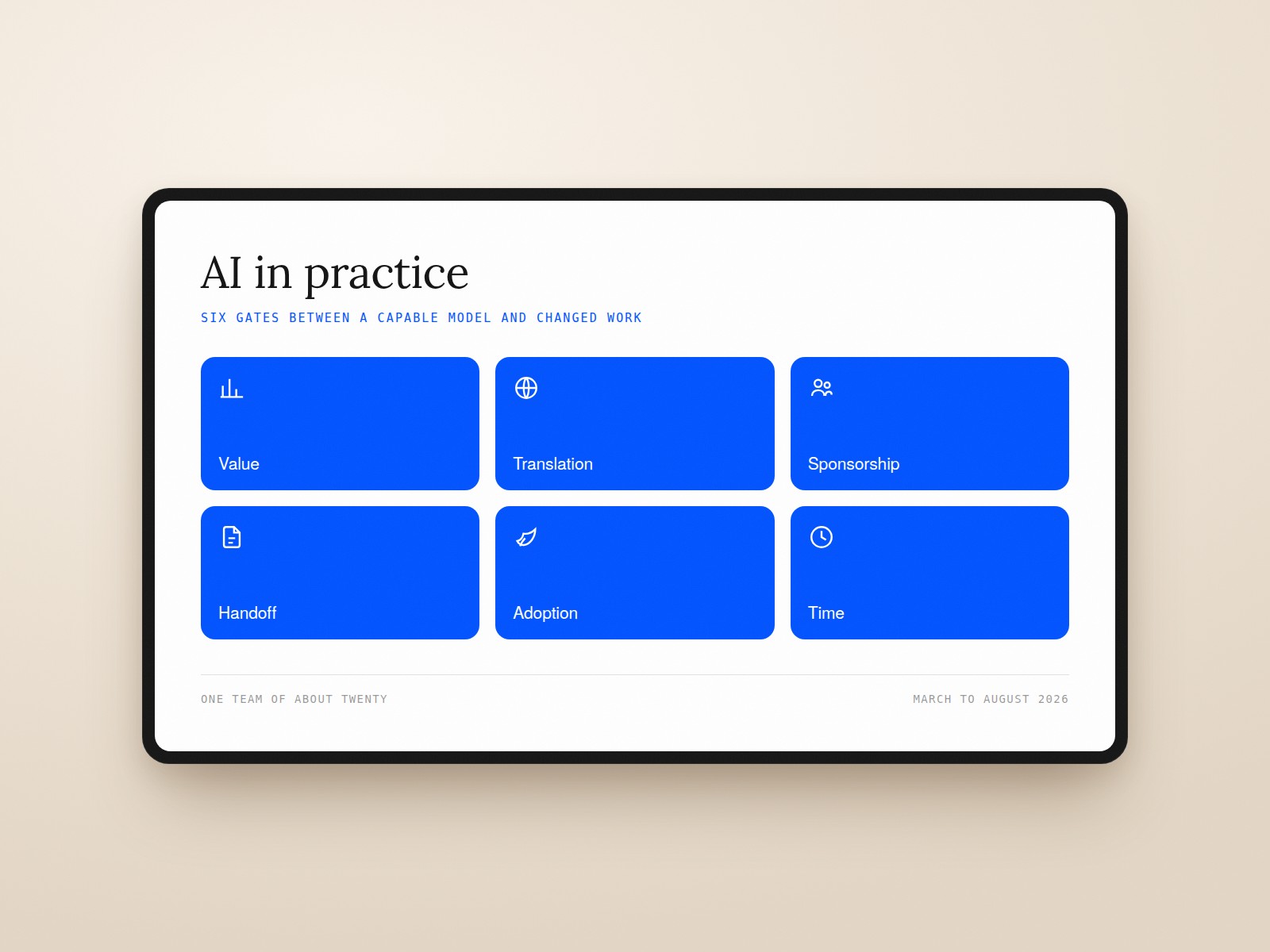
Most AI work dies long before anyone stops using it. Six gates stand between a capable model and changed work. The first, can the model do it, is the one everyone optimizes for, and the only one a launch count measures. The other five are where the attempts we watched actually failed. Under each gate is where our own attempt stopped.

AI in practice, six gates between a capable model and changed work
Six gates between a capable model and changed work. One team of about twenty, March to August 2026.

02 · The six gates

GATE 01

Value

Does the work actually get better?

Stopped here, with the first agent we built.

One of the first agents we built worked exactly as designed. It searched for reference material in the cases where an existing tool came up empty. We were praised for it. Nobody's workload changed, including ours: it saved about a minute, because those searches could already be run one at a time. The interesting part is that the praise came anyway. From the outside, the existence of an agent was proof the team was doing something with AI. From the inside, as its only user, nothing about the week was different. Activity with AI had started standing in for value from AI, partly because activity is countable and value is not.

What changed: the filter we use now is whether the task is repetitive, whether it eats real time, and whether someone would reach for the tool in a normal week without being told to.

GATE 02

Translation

Was it designed with the people who do the work?

Cleared, with the internship.

When we designed a one-month AI project for a summer intern, we could have handed her a list of agents to build. We didn't know what anyone else actually needed, so we started with the people doing the work. The client service associates supplied the context: which steps were slow, what the output had to look like, where the exceptions were, what good meant. They already knew what they wanted changed; what they didn't have was a way to build it, so they handed the execution to her. She had to learn each process well enough to explain it before she could hand any of it to an agent, which is the step most easily skipped. The month produced eight documented agents across account opening, client communication and investment data, plus a handoff package for each. Adoption is partly verified: some moved into real use, she watched one associate use one daily, and one was still being refined on her last day. The other thing the month produced was the person. She told us at the start that she was afraid she couldn't do the project. She finished it able to teach the platform to other people.

GATE 03

Sponsorship

Will someone fund the test, and is there a route to run it?

Stopped here, with an outside research tool.

We found an outside research tool that could pull live financial data in ways general-purpose models couldn't. We proposed a deliberately small test: give a few people access, don't force anyone to use it, watch who reaches for it and for what, then compare that against the seat cost. It died twice, independently, before a single person touched it. Leadership found the analysis convincing and still declined to fund the test; the cost wasn't out of line with what the team spends elsewhere, so we read that as a statement about priority rather than affordability. And being available through an approved platform didn't make the vendor itself approved; we worked through several internal functions and none could point to a route available to a team at that level. So there is no usage data and no ROI number. The absence is the finding: a pilot is a way to buy information, and someone has to be willing to pay for the learning.

GATE 04

Handoff

Is the division of labor right?

Still open, with the deck work.

A client presentation took more than ten hours between first concept and final version. Rather than try to automate PowerPoint, we worked backward from the finished deck to find where the hours went. The model was strong at analyzing the data, surfacing patterns and generating valid directions. It was weak at knowing which insight mattered for this client, and its first set of charts partly repeated what the deck already said. Generation is not judgment, so we stopped asking whether AI could build the deck and redesigned the division of labor instead: the human frames the objective, audience and quality bar; AI organizes, analyzes and drafts; the human validates, prioritizes and owns the result. On a recent deck we used a model to move data and rebuild charts, then checked every recreated figure against the source. When it was presented, we said plainly that a model had done the transfer and that the numbers still needed to be verified by the people signing off. "We used AI" is not an acceptable excuse.

GATE 05

Adoption

Does anyone reach for it next week?

Partly cleared, with the internship agents.

Two groups on the same team, similar access, very different results. The analysts are younger and more comfortable with technology, and that didn't make them easier to move. Analyst value is legible through client coverage, calls, decks and hours, so workflow redesign can look less like real work; the jobs are individual enough that nobody's solution transfers cleanly; and a peer can have opinions about how another analyst should work without any standing to say so. Access, training and pressure from management together still don't add up to workflow redesign. The hardest part is usually not giving someone the tool, it's helping them notice that a task they've always done by hand contains a pattern that could change. "People aren't using it" is a symptom, not a diagnosis.

GATE 06

Time

Who keeps the hours it returns?

Not a gate. An organizational choice.

If a task gives hours back, they can go into more of the same execution or into learning, research and better decisions. Nothing about the technology decides this; the organization does. As production gets cheaper, the human premium moves toward framing the problem, judgment, context, relationships and how fast someone learns. But where long visible hours signal commitment, working faster can cut against the individual even when the organization wants efficiency. A finished deck, a client call, a late night are easy to see; strategy, learning and thinking often produce no artifact at all. AI doesn't only compress production. It puts pressure on the status system built around knowledge work. And an open problem: if juniors learned the work by doing its repetitive parts, and those parts go away, what replaces that as apprenticeship?

03 · What is proven, what is a hypothesis, what is not claimed

We would rather be accurate than impressive.

Observed. The first agent we built saved essentially no time. Eight agents were documented in the internship, at least one in verified daily use. The outside tool was never funded and never cleared. The model was strong on analysis and weak at judging client relevance in deck work. The two groups adopted differently.

Hypothesis, not a result. That the analyst adoption gap is driven by incentives, status and individualized work rather than access. That live market data is the right next place to look. That the reusable deck workflow will hold up once fully tested.

Not claimed. We did not build the eight agents; we designed the program and the intern built them with the people who owned the workflows. We did not run a pilot or secure any clearance. We did not author anyone's firm-level strategy.

04 · Questions we keep returning to

What makes a workflow sticky enough that someone reaches for it without being told?

How do you teach someone to see that a one-off task is actually a recurring one?

If AI gives an employee hours back, who captures that value?

What replaces repetitive execution as the way juniors learn?

How we worked

Study

five months inside one team, noting where each attempt stopped.

Distill

about 70 pages of notes became six gates.

Translate

each gate written as the question a manager would actually ask.

Create

a working note the team could argue with, and a one-month program an intern could run.